Farming & income
Feeding and providing for communities
Throughout rural Africa communities must grow their own food in order to survive and generate income, yet millions of people in Sub-Saharan Africa face severe food scarcity and searing poverty.
67,550
people reached through farming and income work
2,000+
farm families in the cashew project
What makes farming fail here
Children, nursing mothers, and the elderly are hit hardest by food shortages. Poor soil quality, drought, lack of irrigation, lack of access to high yielding seeds, and lack of resources to buy seed for the next season make it extremely challenging for farmers to feed their families and have crops left to sell.
Over 85% of small scale farms depend on rainfall and lack irrigation inputs. Africa's economy is dependent on agriculture, and low productivity has meant rural areas cannot meet their own demand for food.
Eight things we actually do
None of this is theoretical. Each practice below is running today in the villages where we work, taught by our Zambian agronomists.
- Train farmers in sustainable techniques and more efficient farm practices to improve crop productivity.
- Enrich soil with composting, bio char, and green manure crops — bio char and manure alter the soil for years and significantly increase production.
- Secure improved seed varieties from reliable seed-producing agencies.
- Develop and manage irrigation projects that increase productivity and extend the growing season.
- Teach dehydration techniques so fruit and vegetables keep year round.
- Provide the most vulnerable families with chicks and dairy goats, the startup materials, and the training to care for them.
- Run savings groups: a structured way to save, borrow from each other, and learn to manage money — and to trust each other with it.
- Build the market to sell into, so a good harvest becomes income.
The cashew project, step by step
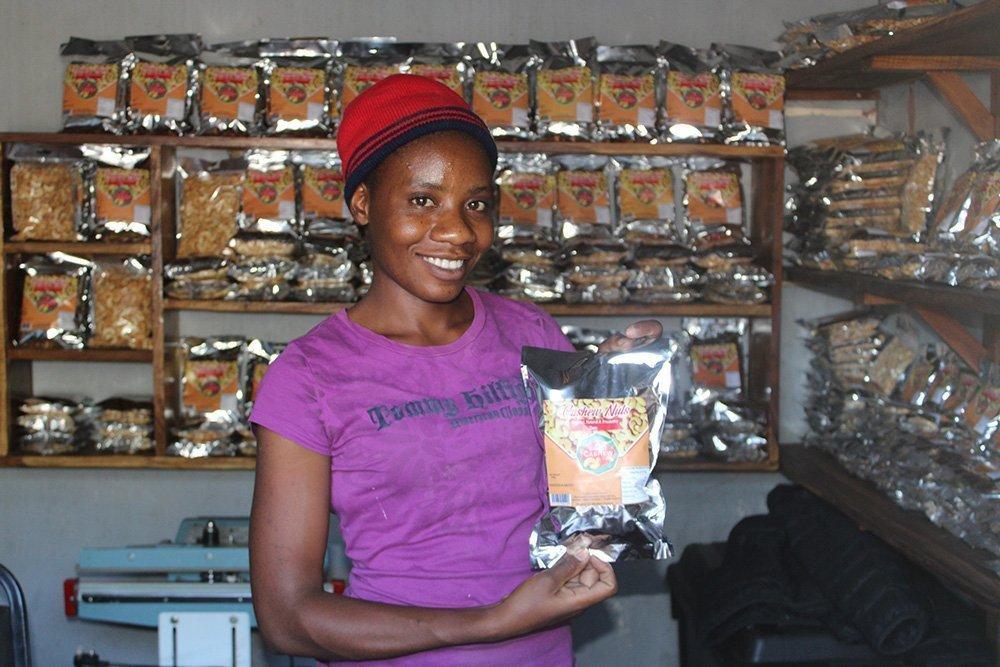
Zambia's Western Province is an excellent environment for cashews, so Hands of Hope established the Barotse Cashew Company as a purchasing, processing and marketing company. It works with over 2,000 farm families and the plant provides jobs in the community. The value chain, end to end:
- Grafting — cuttings from the strongest trees produce stronger seedlings with higher yields.
- Planting — farmers receive the seedlings and are trained to plant and care for the trees.
- Spraying — regular spraying prevents disease in the trees and damage to the nuts.
- Harvesting — farmers collect the nuts and bring them to the purchasing point.
- Buying — the cashews are evaluated, weighed and graded, and farmers are paid in cash.
- Processing — steamed, opened, roasted, peeled and graded before packaging.
- Marketing — sold to airlines, restaurants and stores across Zambia.
An agricultural project launched in 2009 eradicated malnutrition in Mawawa in four years. The community now supplies the Western Province with fresh produce.